High Availability of Scalingo for MySQL®
Scalingo for MySQL® is available across several service classes. Each service class corresponds to a defined availability level and a specific set of features.
High Availability Setups
High availability, clustering, and SLAs are defined by the service class. The architecture model determines the infrastructure and availability-zone placement.
| Service class | High Availability | Cluster composition | Gateways | SLA |
|---|---|---|---|---|
| Starter | No | Single node | 1 | 98% |
| Business | Yes | 1 primary node, 2 secondary nodes | 2 | 99.96% |
| Enterprise | Yes | 1 primary node, 4 secondary nodes | 3 | 99.99% |
The architecture model determines the infrastructure used to run database nodes and the placement of nodes and gateways across availability zones (AZs).
| Architecture model | Database infrastructure | Placement |
|---|---|---|
| Shared Resources | Each database node runs in a container on a shared host | Nodes and gateways remain within one availability zone |
| Dedicated Resources | Each database node runs on its own dedicated virtual machine | For HA plans, nodes and gateways are distributed across up to three availability zones |
Single-node plans
Starter plans are running on a single node, without any redundancy or high availability mechanism. Consequently, we don’t consider them to be highly available. This translates into a lower Service Level Agreement.
Highly Available plans
Business and Enterprise plans are designed for higher service continuity, including during maintenance and platform incidents. They include a fully managed InnoDB cluster using MySQL® Group Replication in single-primary mode: one primary receives writes, while the other nodes maintain replicas of the data.
MySQL® Router instances route client connections to the primary, and all communications between cluster instances are encrypted.
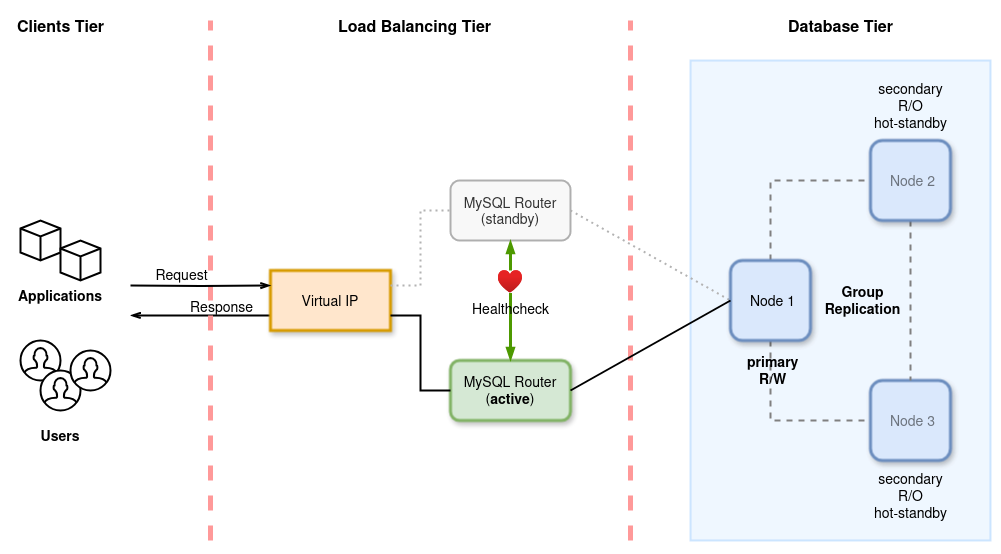
The following schema describes the cluster we setup and maintain for each Business plan:
Business Plans
Business plans include:
- Three (3) MySQL® nodes: one primary and two secondaries.
- Two (2) MySQL® Router instances: one leader and one failover.
Enterprise Plans
Enterprise plans include:
- Five (5) MySQL® nodes: one primary and four secondaries.
- Three (3) MySQL® Router instances: one leader and two failovers.